

A Parent’s Guide for the New School Year
A New School Year Is a New Opportunity to Learn, Grow and Excel
A new academic session brings a fresh start.
New books are purchased. School uniforms are prepared. Classrooms become busy again. Students reconnect with friends and teachers, meet new challenges and begin working towards new academic goals.
But one of the most important things children need at the beginning of a new school year is not simply new school supplies. They need good study habits.
Good study habits help children become more organised, focused and responsible learners. They can also make schoolwork less stressful because children learn how to manage their time, prepare for assessments and take greater ownership of their education.
At Covenant Child Academy (CCA), education goes beyond preparing children to obtain good grades. The Academy’s stated mission is to groom the total child and empower learners for successful leadership with moral uprightness. Its vision is to raise smart, knowledgeable, confident, articulate and talented boys and girls with spiritual prowess.
Developing effective study habits is an important part of that journey.
So, how can parents help?
1. Establish a Consistent Study Routine
Children generally benefit from knowing what to expect.
Rather than waiting until an examination is approaching before encouraging your child to study, establish a regular routine from the beginning of the term.
A study routine could include:
- A designated homework period
- Reading time
- Revision time
- Breaks for relaxation
- Preparation for the following school day
The routine does not need to be complicated.
For younger children, even 20–30 minutes of focused reading or revision can be productive. Older students may require longer periods depending on their workload and individual learning needs.
The important thing is consistency.
A child who develops the habit of studying regularly is less likely to depend entirely on last-minute revision.
2. Create a Suitable Study Environment
The environment in which a child studies can influence concentration.
Parents should, where possible, provide a reasonably quiet and well-lit area where the child can complete schoolwork without unnecessary interruptions.
The study area should have the basic materials the child needs, such as:
- Books
- Exercise books
- Writing materials
- Relevant learning resources
- A comfortable chair and table
It does not have to be an elaborate home study room.
What matters most is creating a space that signals:
“This is a place where I focus and learn.”
3. Help Your Child Set Academic Goals
Children should learn that education is not simply about completing homework or passing examinations.
Encourage your child to set realistic goals.
For example:
“I want to improve my mathematics score this term.”
Or:
“I want to read one book every month.”
Or:
“I want to participate more actively in class.”
Goals should be specific and achievable.
Parents can then help children review their progress without turning the process into unnecessary pressure.
The objective is to help children develop self-motivation and personal responsibility.
4. Teach Your Child How to Manage Time
Time management is a valuable life skill.
As children progress through school, they increasingly have to balance different subjects, assignments, revision, extracurricular activities and personal responsibilities.
Help your child understand the difference between:
“I have plenty of time.”
and
“I have planned my time.”
A simple weekly timetable can make a significant difference.
For example:
| Activity | Suggested Time |
|---|---|
| Homework | After returning home/rest |
| Reading | 20–30 minutes |
| Revision | According to subjects |
| Recreation | Planned free time |
| Preparation for school | Evening |
The schedule should remain flexible enough to accommodate the child’s age, workload and family routine.
5. Encourage Reading Beyond School Textbooks
Reading should not become something children associate only with examinations.
Encourage your child to read stories, biographies, educational books, magazines and other age-appropriate materials.
Reading helps children develop vocabulary, comprehension, imagination and communication skills.
It can also support performance across different subjects because students who understand what they read are better positioned to engage with written instructions, questions and learning materials.
At CCA, communication and learning are important parts of the educational experience. The school’s Montessori pre-school programme, for example, places emphasis on helping young children express themselves through speaking and listening activities.
Parents can reinforce this development at home by making reading a regular part of family life.
6. Teach Children to Understand, Not Just Memorise
Memorisation has its place in education, but meaningful learning goes beyond remembering information.
Encourage your child to ask:
- Why?
- How?
- What does this mean?
- Can I explain this in my own words?
- Where can I use this knowledge?
For example, instead of simply memorising a scientific definition, encourage the child to explain the concept to you.
If your child can teach you something in simple language, that is often a good indication that they understand it.
This approach also supports the type of critical thinking, creativity and problem-solving skills that children need beyond school.
7. Encourage Children to Ask for Help
Some children struggle academically because they are afraid to admit that they do not understand something.
Parents should create an environment where asking questions is encouraged.
Teach your child that saying:
“I don’t understand this yet.”
is not a sign of failure.
It is the beginning of learning.
Children should feel comfortable seeking clarification from parents, teachers and other appropriate sources when they encounter difficulties.
A strong relationship between home and school can make this process easier.
8. Teach Your Child to Break Big Tasks Into Smaller Tasks
A large assignment can feel overwhelming.
Instead of telling a child:
“Go and finish all your work.”
help them break it into manageable steps.
For example:
Science Project
- Understand the topic.
- Research the information.
- Organise the ideas.
- Prepare the materials.
- Complete the project.
- Review the work.
- Make corrections.
This approach teaches children how to approach complex tasks systematically.
That is a skill that will remain valuable throughout their education and eventually in the workplace.
9. Manage Distractions—Especially Digital Distractions
Technology can be an excellent educational resource, but it can also become a major distraction.
Phones, social media, games, videos and constant notifications can make it difficult for children to concentrate.
Parents should establish reasonable boundaries around recreational screen time, particularly during homework and study periods.
At the same time, technology should not simply be viewed as the enemy.
Children need digital literacy.
CCA has demonstrated an interest in preparing students for the digital future, including its Digital Citizen 2026 programme, which introduced students to areas such as AI productivity, Canva AI, Google Gemini, video editing, animation and other digital skills.
The goal should therefore be responsible technology use.
Children should learn the difference between using technology to learn and using technology simply to be entertained.
10. Encourage Rest, Sleep and Healthy Balance
Studying for long hours without adequate rest does not necessarily produce better learning.
Children need time for:
- Sleep
- Physical activity
- Play
- Family interaction
- Relaxation
- Hobbies
- Social development
A balanced routine can help children approach schoolwork with greater energy and concentration.
CCA’s educational philosophy recognises that developing the whole child involves more than academics. Its programmes include leadership development, entrepreneurship, arts, music, technology and other activities designed to develop students’ wider skills and abilities.
Academic success should therefore exist alongside healthy personal development.
Parents Should Encourage, Not Take Over
One of the most important lessons parents can teach children is independence.
It can sometimes be tempting to do things for a child because it is faster or because the parent wants the work to be perfect.
But if parents consistently complete assignments, provide every answer or organise every aspect of a child’s schoolwork, the child may not develop the independence needed to manage learning alone.
Instead, parents can:
- Ask guiding questions.
- Help children plan.
- Explain difficult concepts.
- Encourage them to try again.
- Review completed work.
- Communicate with teachers when necessary.
The goal is not to eliminate every challenge.
The goal is to help the child learn how to overcome challenges.
Good Study Habits Begin With Small Steps
Parents do not need to completely transform their child’s routine overnight.
Start with simple habits.
Read every day.
Keep school materials organised.
Complete assignments on time.
Prepare for school the night before.
Review lessons regularly.
Ask questions when something is unclear.
Limit unnecessary distractions.
Take adequate rest.
Over time, these small behaviours can become habits that support academic confidence and independence.
The Role of the School and the Home
Developing good study habits is not solely the responsibility of parents or teachers.
It is a partnership.
Teachers provide instruction, guidance, feedback and academic support. Parents reinforce positive routines at home. Students themselves gradually learn to take responsibility for their progress.
This partnership is particularly important at the beginning of a new academic year.
At Covenant Child Academy, continuous improvement extends to the educators themselves. Ahead of the 2026/27 academic session, CCA organised a two-day staff capacity-building workshop led by Folashade Adefisayo, who served as Honourable Commissioner for Education in Lagos State. The training addressed areas including effective teaching and learning, classroom management, leadership, teamwork, professional development and quality service delivery.
This reflects an important principle:
When the adults supporting children continue to learn and improve, children benefit too.
A New Academic Year, A New Opportunity
The beginning of a school year is more than a return to the classroom.
It is an opportunity for children to develop better habits, set new goals, overcome previous challenges and discover new abilities.
Whether your child is beginning Montessori education, progressing through primary school or preparing for the demands of secondary education, the habits developed today can influence the learner they become tomorrow.
At Covenant Child Academy, the goal is not simply to help students achieve good grades. The Academy’s educational philosophy places emphasis on developing confident, knowledgeable and responsible young people equipped for leadership and life.
And that journey begins with everyday habits.
One page read.
One assignment completed.
One concept understood.
One goal achieved.
One better habit at a time.
Final Thoughts for Parents
As the new academic session gets underway, take some time to speak with your child about their goals for the year.
Ask them:
What would you like to improve?
What subject do you enjoy most?
What do you find difficult?
What would you like to learn this year?
Most importantly, remind them that learning is a journey.
There will be difficult subjects, challenging assignments and occasional setbacks. What matters is learning how to respond—to ask questions, keep trying, seek help and continue growing.
That is how good study habits become lifelong learning habits.
At Covenant Child Academy, We Believe in the Total Child
From Montessori education and primary learning to college education, leadership development, technology, arts, music and personal development, CCA’s programmes are designed around the development of the whole child.
As a new academic year begins, we look forward to another year of learning, growth, character, achievement and excellence.
Welcome to a new school year at Covenant Child Academy.
Let’s make it a year of purpose, progress and possibility.
Suggested Internal Links
This article should link naturally to:
- About Covenant Child Academy
- Montessori Pre-School
- Elementary School
- College
- Admissions
- Leadership Education
- Digital Citizen / Technology Programmes
- Recent School News
- Contact / Enquiries
Suggested Featured Image
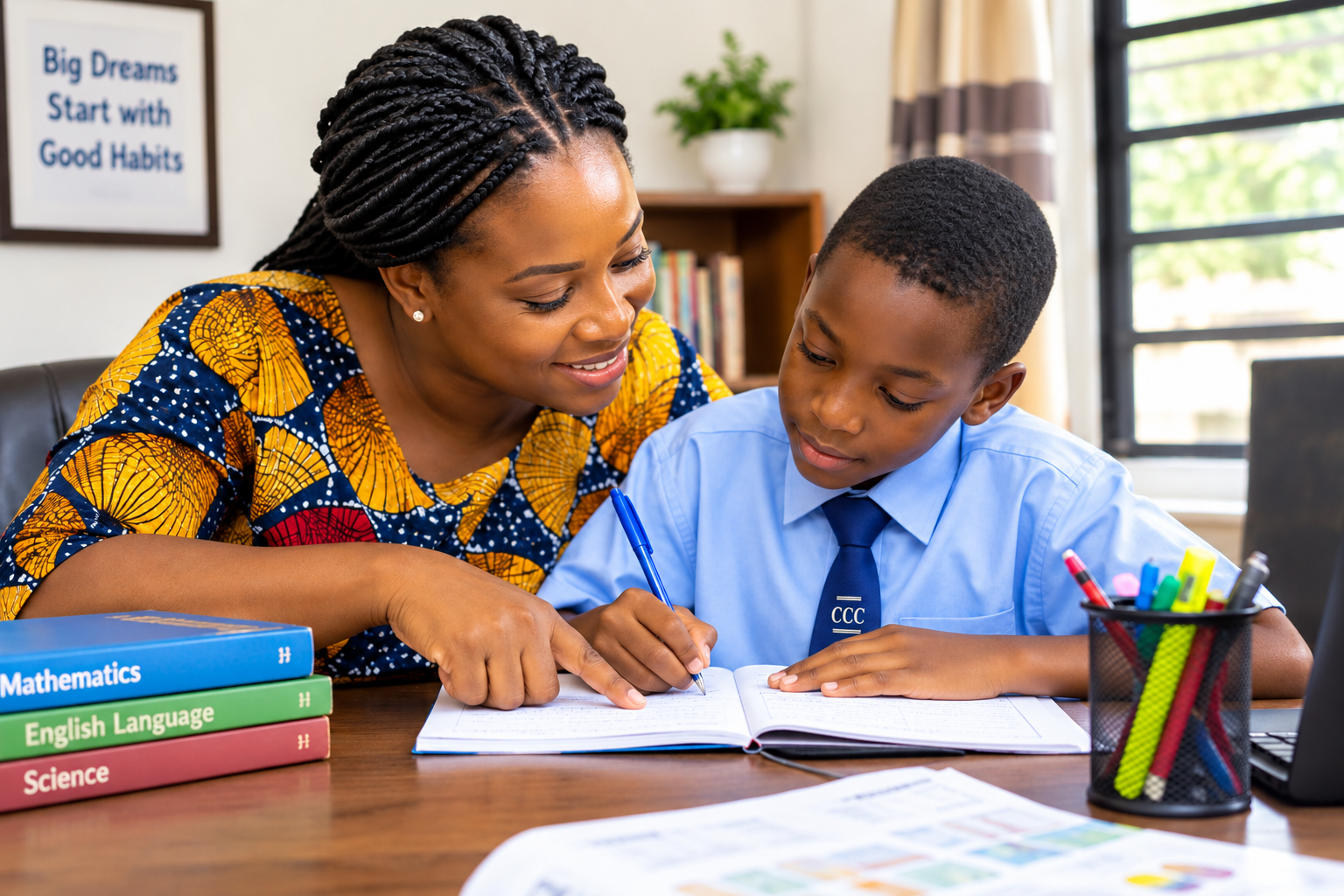
A high-quality photograph of a CCA student in the school uniform studying at a desk, preferably with books and learning materials visible. The image should feel natural and authentic to CCA rather than looking like a generic stock photograph.
Suggested image headline:
GOOD STUDY HABITS, GREAT FUTURES
Suggested subtext:
Helping Your Child Start the New Academic Year Strong.